
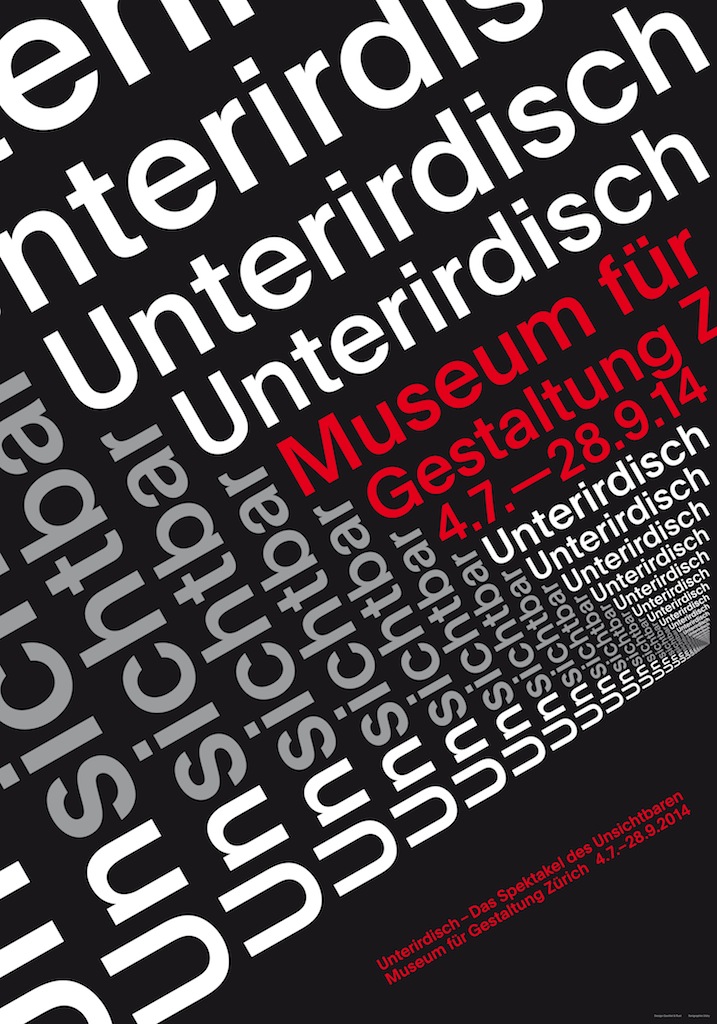
Gavillet & Rust, poster of the exhibition „Underground– The Spectacle of the Invisible” at Museum für Gestaltung Zürich, 2014, © ZHdK
Museum Gestaltung Ausstellungsstrasse 60 CH-8005 Zürich CH-8031 Zurich Allemagne
Underground railway stations and huge tunnels, basement clubs and secret bunkers – we are spending increasing amounts of our lives underground. In a new exhibition the Museum für Gestaltung makes visible this immensely wide-branching reality under the surface.
It is difficult to imagine how our lives would be without all the underground train stations and cinemas, without the tunnels, water reservoirs and service pipes. The exhibition “Underground – The Spectacle of the Invisible” investigates these man-made spaces beneath ground level for the first time in Switzerland. In Switzerland this is a particularly topical theme, as in the short period since the start of the new millennium the volume of all tunnel and shaft constructions has practi- cally doubled. This is due in part to the Alpine Base Tunnel and the Durchmesserlinie in Zurich. But why are we increasingly building underground?
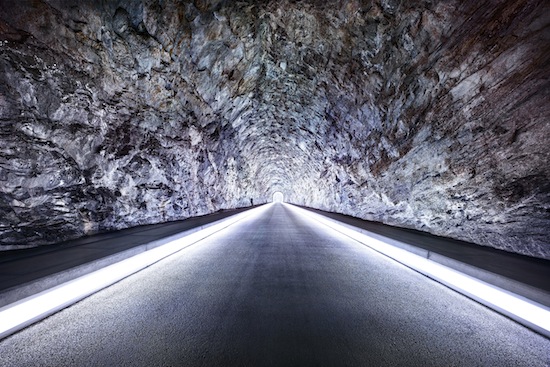
Luca Zanier, Access Tunnel to the Underground Central, Ferrera (Finished 1963), 2011, © Luca Zanier Photography, Zürich
Protection and free space
The reality of the underground exists in a field of tension defined by possibility, necessity and wishful thinking. For many structures a location underground is chosen for purely pragmatic re a- sons, as a way of creating additional space – for instance for garages or for the food depart- ments of supermarkets. Other complexes are put below ground level out of necessity, as they are more protected or more discreet there. This applies to spaces for religion or research just as much as to the Government bunker, which is so secret that officially it does not even exist. On the other hand underground or independent culture takes over empty spaces as places for a utopia, where freedom appears unlimited. The potential of unused space beneath the earth has been recognized not only by basement clubs, cinemas and theatres but also by those who run established cultural or data storage facilities. In such adaptations the factor time is of major im- portance. The underground structure, which is always extremely solidly constructed, generally outlives what is built above ground level.
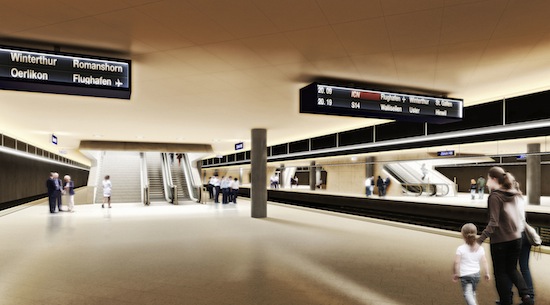
Dürig AG, Throug Station Löwenstrasse, Zurich, 2014, visualisation: raumgleiter, © SBB
Designing the invisible
In addition to examining the reasons for building underground the exhibition also takes a look at the design of underground spaces and enquires how specific places are created through the use of space, material, colour and light. Although underground structures are designed in many dif- ferent ways they all have one thing in common: they lack an external appearance. The structures may be small or large, but they are never real buildings. Only the entrances at the transition be- tween under and above ground can be given an architectural form and indicate what lies below. In view of the great significance of the underground visual media have developed processes to make the invisible understandable. One milestone in the history of this process of making visible was the plan of the London Underground from the 1930s, which presented the transport network as a system and emphasized the options for changing from one line to another. This plan design had the disadvantage that it strongly distorted the real geography. But its advantages for travel- lers are so striking and numerous that other transport systems adopted it.
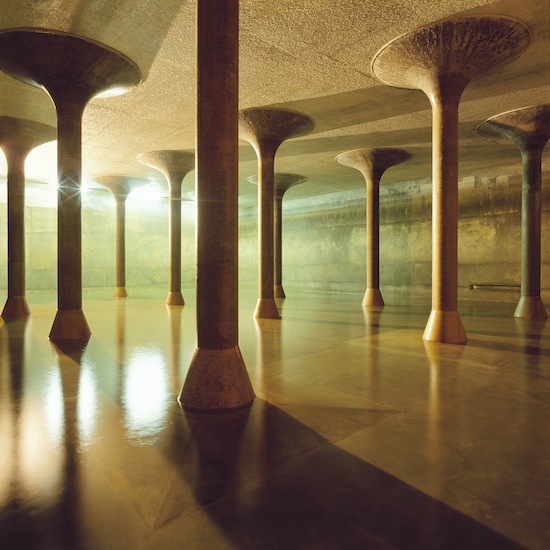
Silvio Maraini, Reservoir Ibruch, Zumikon (Finished 1967), from the Series Geflutete Kathe- dralen, 2011, © with the photographer
Life underground
The underground occupies in an existential way those people who spend a significant part of their life below ground level because they work or find shelter there. In contrast those who make feature films follow their own specific filmic interests and present the underground in a way that has less to do with everyday experience and more with the public’s delight in feeling fear. They build up their narratives and their drama on the cramped conditions, the darkness, the labyrin- thine or eerie quality that we like to attribute to the underground.
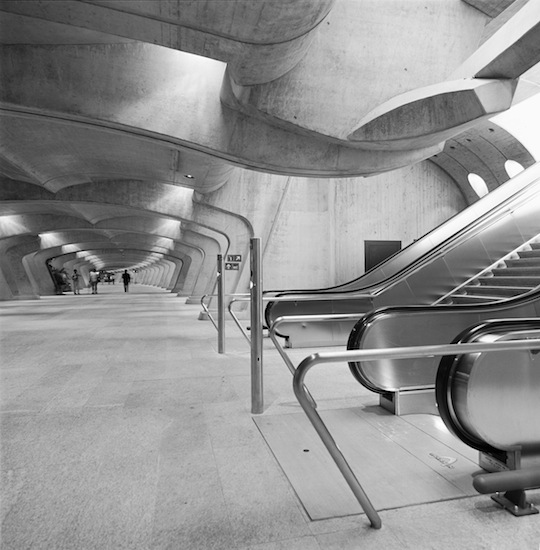
Santiago Calatrava, Trainstation Stadelhofen, Zurich, 1990, photo: Paolo Rosselli (1991), © with the photographer
Scenography of the underground
In seven thematic spaces, whose scenographic design is inspired by the underground, the exh i- bition uses models and photos, videos and graphics, some of them specially made, to present important national and international structures from the present day. The example of Zurich is used to show the high density of use of the underground in the modern-day city. The under- ground becomes visible as an independent habitat, which in the future will most probably shape our cities and our landscape to an ever greater extent than is already the case today.
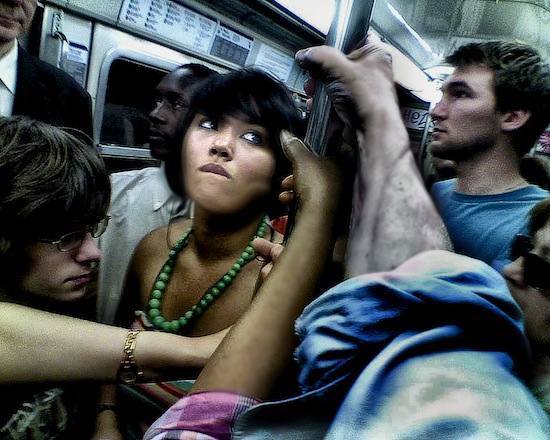
Chris Marker, Untitled 188, from the Series Passengers, 2011, © Peter Blum Gallery, New York
Opening : Thursday, 3 July 2014, 7 pm